


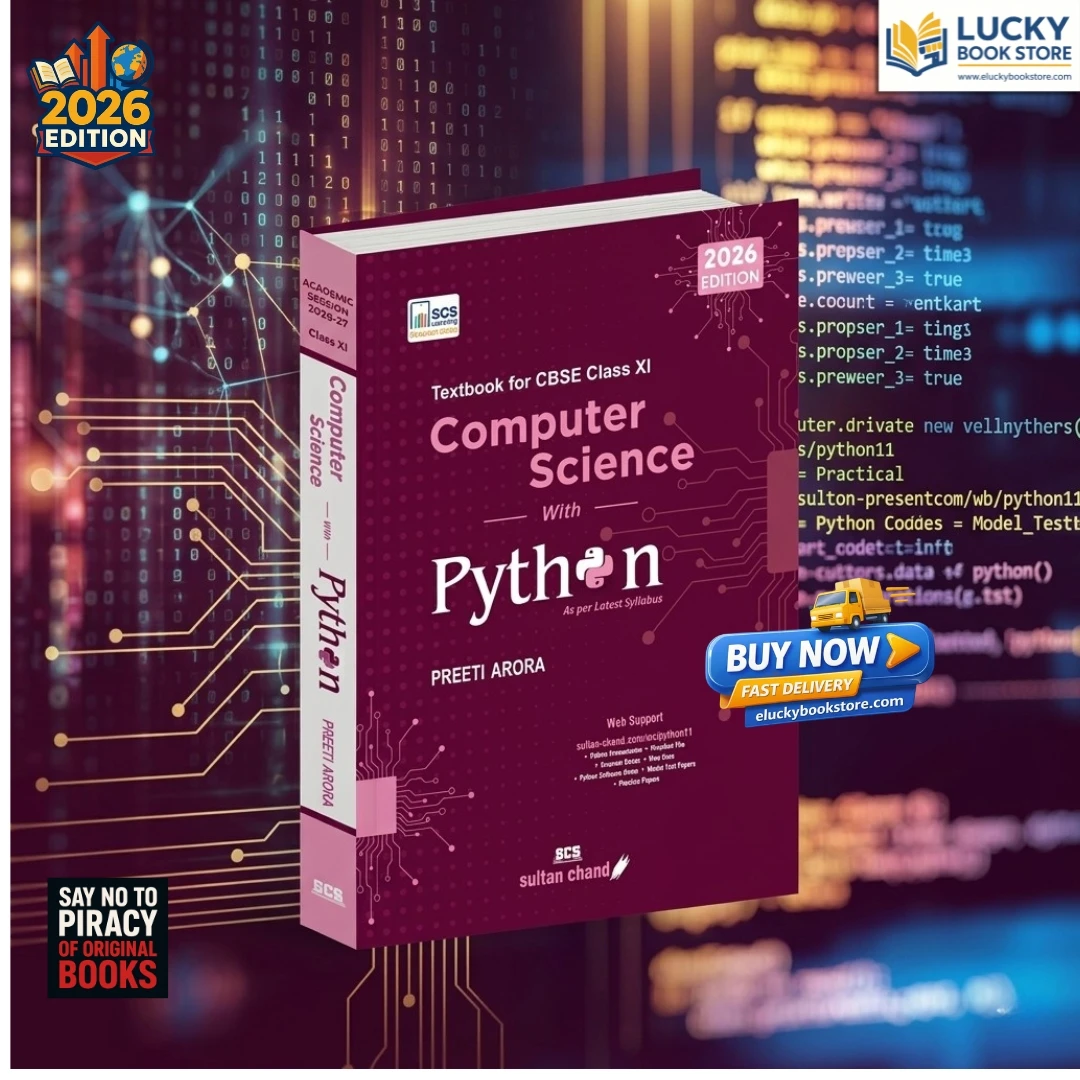
Class 11 CBSE Computer Science With Python by Preeti Arora 2026 Edition | Sultan Chand
🚚 Online Exclusive 🌐
⚠️ Price may differ from offline store. This special pricing is applicable only for online orders at eluckybookstore.com.
- 💰 MRP: ₹775.00 (Inclusive of all taxes) 💯
- 🗣️ Language: English 🇬🇧
- 📚 Subject: Computer Science (Python) 💻
- 🎓 Standard: Class 11 (CBSE) 🏫
- 📖 Binding: Paperback 📑
- 🏢 Publisher: Sultan Chand & Sons
📘 Book Name: Computer Science with Python for Class 11 💻
✍️ Author: Preeti Arora
🏢 Publisher: Sultan Chand & Sons
📅 Edition: 2026 (Latest) ✨
🎓 Board: CBSE Class 11 🏫
The Class 11 Computer Science with Python textbook by Preeti Arora is a masterfully crafted resource for students embarking on their computer science journey 🚀. This 2026 Edition is strictly aligned with the latest CBSE syllabus and guidelines. Known for its clear explanations and hands-on approach, this book makes learning Python programming and computational thinking both easy and engaging 🧠.
✨ Key Features:
- ✅ Python Mastery: Comprehensive coverage of Python fundamentals, from basic syntax to advanced data structures like lists, tuples, and dictionaries 🐍.
- ✅ Computational Thinking: Focuses on problem-solving techniques and algorithmic thinking to build a strong programming foundation 💡.
- ✅ Society, Law, and Ethics: Detailed chapters on the impact of technology on society, cyber safety, and intellectual property rights 🌍.
- ✅ Hands-on Learning: Abundant solved examples, code snippets, and practical exercises to reinforce learning through practice 📝.
- ✅ Exam-Oriented: Includes previous years' questions, NCERT-based exercises, and sample papers tailored to the CBSE pattern 🏆.
-
📦 Product Identity & Origin
- 🔖 Commodity Name: Class 11 CBSE Computer Science Textbook
- 🌍 Country of Origin: Made in India 🇮🇳
- ⚖️ Net Quantity: 1 Unit (Book) 📘
💸 Pricing & Manufacturing Details
- 🏷️ Maximum Retail Price (MRP): ₹775.00 (Inclusive of all taxes) 💯
- 📅 Month & Year of Publication: February 2026 🗓️
- 🏭 Publisher Name: Sultan Chand & Sons
- 📍 Publisher Address: New Delhi, India 🏢
🛍️ Packer & Seller Details
- 📦 Packed & Marketed By: Lucky Book Store 🏬
- 🏠 Seller Address: U-3/4 Maher Park-B, Opp. Vanita Vishram Ground, Athwagate, Surat, Gujarat 395001 📍
- 🌐 Website: eluckybookstore.com
📞 Consumer Support & Grievance Redressal
For queries ❓, feedback 💬, or complaints 🛠️, please reach out to our customer support desk:
- 👨💼 Customer Care Executive: +91 96875 43399 📱
- 🏢 Office Address: U-3/4 Maher Park-B, Opp. Vanita Vishram Ground, Athwagate, Surat, Gujarat 395001 📌
- ⏰ Operating Hours: Monday to Saturday, 11:00 AM to 7:00 PM (IST) ⏳
📦 Shipping Policy
- ⚡ Orders dispatched within 24–48 working hours.
- 🚛 Delivery time: 3–7 working days (location dependent).
- 📍 Tracking details shared immediately after dispatch 📲.
- ❌ Orders cannot be cancelled once they have been shipped 🚫.
🔁 Return & Cancellation Policy
- 📌 Returns accepted only for damaged 💥, defective ⚠️, or wrongly delivered items 📦.
- 📷 Unboxing video is strictly mandatory 📹 for all damage or missing item claims.
- ⏳ Please report any issues within 48 hours of successful delivery ⏱️.
- 💰 Refunds will be processed swiftly after verification of the claim 💳.
- 🚚 If an order is cancelled after it has been shipped or delivered, the shipping cost will not be refunded 📉.
Based on the CBSE curriculum, the book has been divided into three units:
Unit I: Computational Thinking and Programming-2 – Chapters 1 – 5
This unit contains five chapters covering a review of Python studied in Class XI, the concept of functions and modules in Python, Exception Handling using try-except-finally blocks, Text, Binary file-handling operations involving read, write and append operations and CSV file-handling operations involving reading from a CSV file and writing into a CSV file, Standard input-output and error streams and relative and absolute paths for a file. Besides, implementing Python Data Structures, viz. Stacks using Lists, have also been thoroughly discussed.
Unit II: Computer Networks – Chapter 6
This unit covers the concepts of Computer Networking, the Evolution of Networking, Data Communication terminologies, Transmission Media, Network Devices such as Hubs, Switches, Repeaters, Gateways, Routers, Wi-Fi Cards, Ethernet Cards, etc., Network Topologies and Protocols, Introduction to Web Services such as WWW, Website, Web Server, Web Hosting, DNS, etc., and Setting up a Computer Network.
Unit III: Database Management – Chapters 7 and 8
This unit covers Database Concepts, Relational Database Model, SQL Commands, and Aggregate Functions such as SUM(), AVG(), COUNT(), MAX() and MIN() along with important SQL Clauses such as GROUP BY, HAVING and ORDER BY. It also covers the concept of SQL Joins, viz. Equi-join and Natural join and Python-MySQL Connectivity.
You may also like


 Track Your Order